Legal work is still largely organised around documents.
A regulatory application might sit in one folder, the regulator’s first-round comments in another, the applicant’s responses in a third, and revised policies somewhere else again. Each document may be carefully named, indexed and searchable. Yet the most important thing is often missing: the relationship between them.
That relationship is where the legal work actually happens.
Consider a regulator that raises a governance concern in round one. The applicant provides a general response. In round two, the regulator returns to the issue, but asks for a formal control and implementation roadmap. By round three, the concern has narrowed again: the policy may now exist, but evidence of an appointment or completion date remains outstanding.
In a folder, those are three separate comments in three separate documents. In substance, they are one evolving issue.
The limits of the document view
Conventional document review is good at answering questions such as: Where does this phrase appear? or Which file contains the latest response?
It is less effective at answering:
- Is this a new concern, or the continuation of an earlier one?
- Did the applicant’s response resolve the concern, narrow it or merely restate its position?
- Which regulatory guidance sits behind the request?
- What evidence was promised, and was it ever delivered?
- Which issues recur across governance, custody, outsourcing or technology?
- What remains open after three rounds of correspondence?
These are not principally questions about documents. They are questions about connections, changes and dependencies.
This became particularly clear in a recent exercise mapping successive rounds of regulatory comments and responses. A conventional table could record each comment, its response and the relevant guidance. It could even assign a status such as partial or substantively answered. But once an issue crossed rounds, changed wording or split into more specific requests, the table became harder to read.
The chronology was visible. The structure was not.
The issue—not the comment—as the unit of analysis
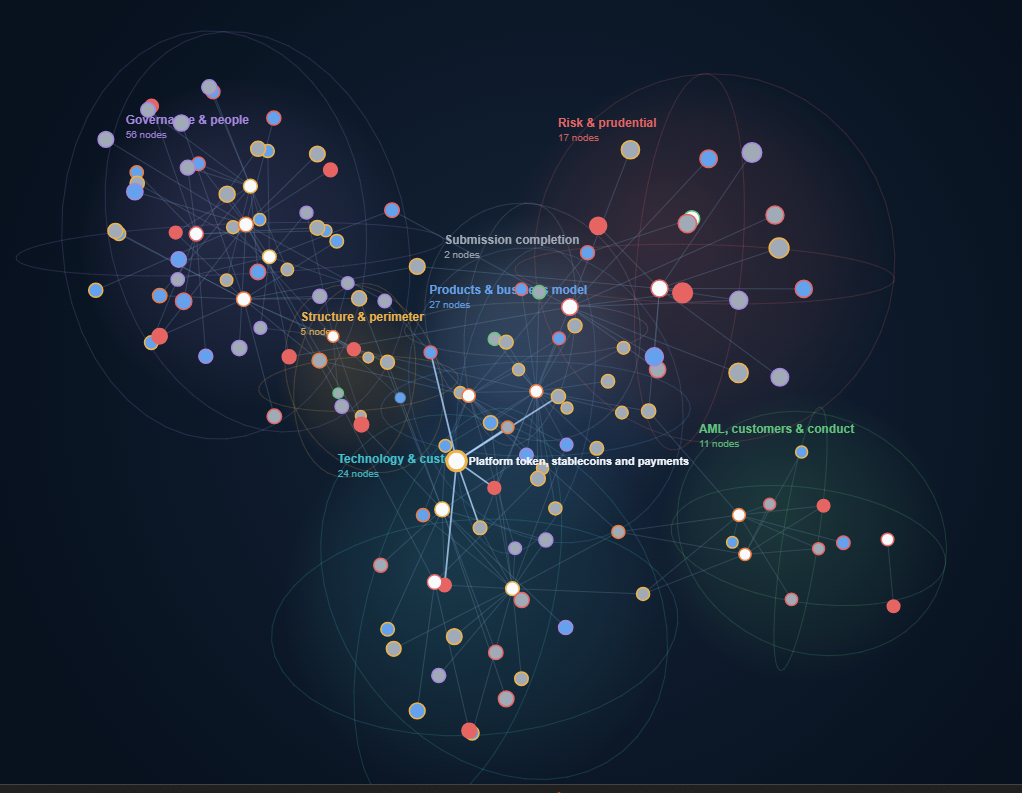
A force-directed graph offers a different model.
Instead of treating each document or comment as an isolated record, the graph represents them as nodes. Links show the relationships between regulatory concerns, applicant responses, underlying guidance, evidential gaps, required actions, review rounds and source documents.
Connected nodes naturally gather together. Recurring concerns form visible clusters. A heavily connected governance issue occupies a different position from a discrete drafting point. A response that addresses several regulatory requests becomes visibly important. An outstanding action can remain attached to the original concern even when later correspondence uses different language.
The result is not simply a more attractive diagram. It changes the unit of analysis.
The central object is no longer “comment 14 in the second letter.” It is the stable regulatory issue running through the review—for example, board independence, custody controls or the transparency of a group structure. Each comment, response, policy amendment and item of evidence becomes part of that issue’s history.
| Round | Regulatory concern | Effect of response | Remaining position |
|---|---|---|---|
| 1 | Board independence and dual-hatting | General mitigants described | Materially partial |
| 2 | Formal independence controls and roadmap requested | Policy and roadmap supplied | Concern narrowed |
| 3 | Appointment and timing requested | Candidate identified | Appointment evidence outstanding |
The table remains useful. The graph makes clear that all three rows belong to the same continuing question—and shows what else that question touches.
Preventing “silent closure”
This approach also addresses a subtle risk in multi-round regulatory work: silent closure.
If a concern does not appear in the regulator’s next letter, it is tempting to mark it as resolved. But absence is not necessarily closure. The regulator may have prioritised other matters, assumed that promised evidence will follow, or simply not repeated the point.
A defensible review method should therefore distinguish between:
- explicit closure by the regulator;
- closure supported by evidence reviewed against the original request;
- an issue narrowed by a later response;
- an issue that remains open; and
- an issue that is merely absent from later correspondence.
In a graph, an issue does not disappear because the next document is silent. It remains connected to the unresolved gap or promised action until there is a proper basis for changing its status.
That is more than good project management. It creates an auditable account of why the legal team concluded that an issue was resolved.
From filing system to reasoning interface
Force-directed graphs are not a replacement for legal judgment, source documents or structured tables. Nor does spatial proximity itself prove a legal relationship. The value depends on careful classification: links must reflect substantive continuity, not merely repeated terminology.
But used properly, the graph becomes a reasoning interface over the underlying record.
A lawyer can begin with an unresolved governance node and move outward: to the regulator’s original request, the applicant’s successive answers, the relevant guidance paragraphs, the policy supplied in response, and the final evidential gap.
A supervising partner can see where a matter is becoming concentrated. An applicant can understand why an apparently modest follow-up question is really the latest expression of a concern that has persisted from the first round.
The same model has applications beyond licensing reviews. It could map contractual obligations to operational controls; legislative provisions to guidance and enforcement decisions; due-diligence findings to remediation actions; or legal opinions to the factual assumptions on which they depend.
In each case, the graph exposes something that the folder conceals: legal knowledge is not a stack of documents. It is a network of propositions, evidence, authority, decisions and unresolved dependencies.
A more natural interface for complex work
For simple matters, the folder will remain perfectly adequate. For complex regulatory work, however, the native interface may increasingly be the relationship map, with the document available behind each node as evidence.
That reverses the conventional arrangement. Today, we open a document and try to reconstruct its connections. Tomorrow, we may begin with the connections and open the document only when we need to inspect the source.
Search helps us find what has been written. A well-constructed graph helps us see what the matter means—and what still needs to be done.
BeesMont Fintech is the specialist digital-assets, AI and fintech practice of BeesMont Law Limited. This note provides general information only and does not constitute legal advice.